What to say about Evan Dara that hasn’t been said already? Dara belongs to a group of writers that, having read them, make me feel as if I’ve gained entrance to a kind of privileged club, like I’ve become in-the-know. Dara is often described as a well-kept secret in American literature, although this is clearly by choice: Dara is, famously, hermetic. There is speculation that the name “Evan Dara” is in fact a pseudonym, with some hazarding the suspicion that he is actually the writer Richard Powers, though as one reader put it, “If Powers really is Dara, then he has no business writing anything more as Powers.”
I started reading Dara’s most recent novel, Flee, after stumbling, wide-eyed, through his debut The Lost Scrapbook. My experience of reading big novels like that can be like climbing up a tall hill, forging through the thickets and sweating it out for a while, eventually reaching the peak, enjoying the view, and then galloping down the scree and careening towards the valley below at a breakneck pace. Big novels often present a commanding landscape that I have to adapt to, which is to say that I have to learn how to read them. At some point I tip over into having some sort of understanding of, you know, what it is the author is doing and how things are proceeding. Once things truly start to click, usually in the last quarter of the book, I have become so immersed in the logic of the book, in its style and architecture, that I get syncopated into a certain double-time rhythm and read much quicker and at a much more fluid pace than before. Most recently I experienced this reading Samuel Delaney’s opus Dhalgren; I felt this way with The Lost Scrapbook.
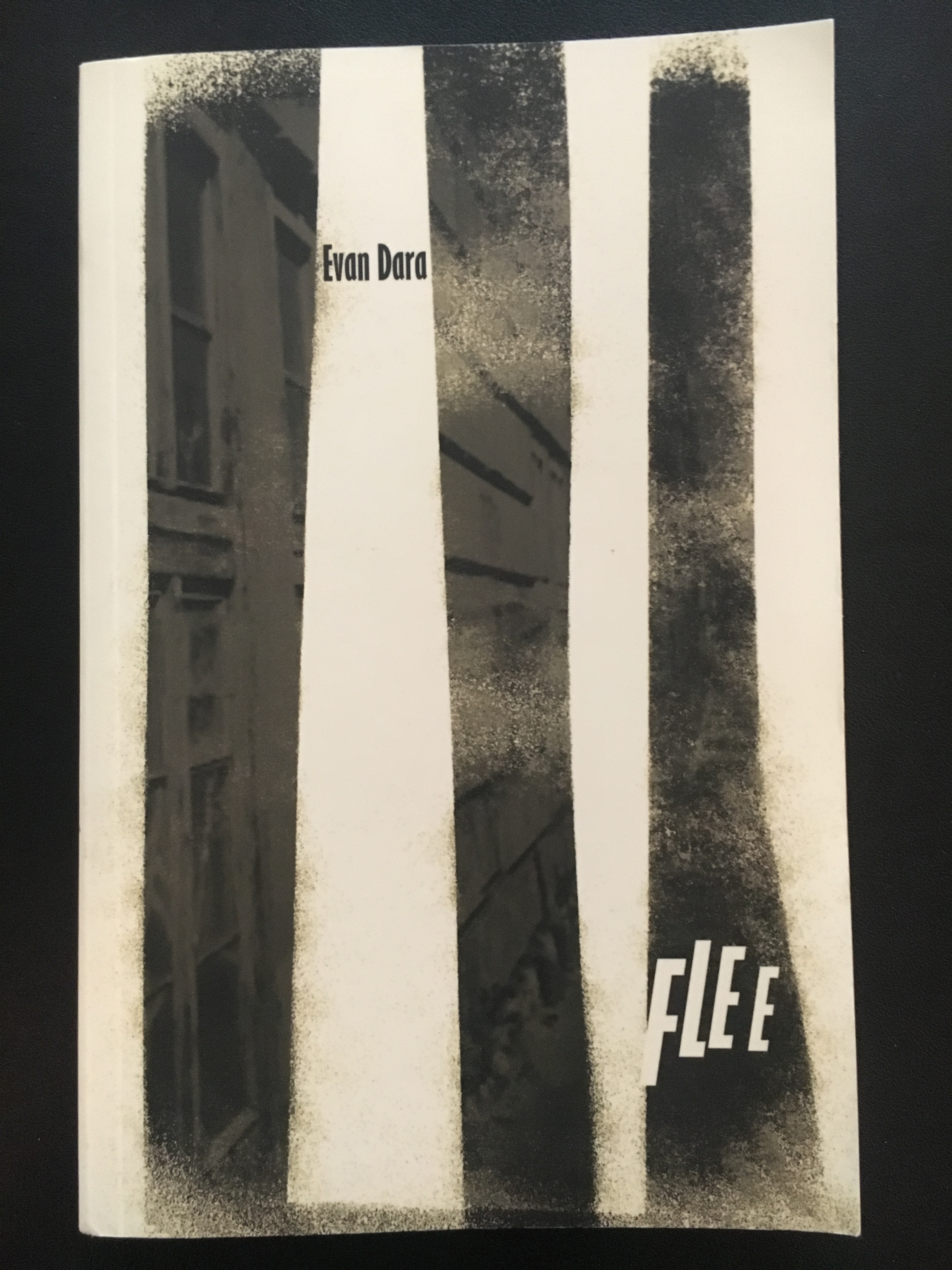
But to the point: Flee. The novel is about the collapse of Anderburg, Vermont, triggered by the collapse of its local university and major employer Pitkinson. An inquiring student wants to take a sociology course, wants to major in the subject in fact, only to discover that the department, courses and all, exists only on paper. But the plot itself is ancillary to Flee; the real central organizing feature, the main attraction, is Dara’s narrative technique. The first analogy that comes to mind is the Greek chorus, although where the chorus functions as an expository device, supporting the main narrative, here I would argue that the polyvocal narrative is the central plot of the book. This book is not as radical in its commitment to the multitude-of-voices narrative technique as The Lost Scrapbook, however; there are a few characters who emerge from the current and are given their own sections conducted by a third-person narrator. For most of the novel these sections are given to Rick and Carol, a couple trying to stem the tide of Anderburg’s demise by creating a staffing agency to fill the many local vacancies. This story drifts in and out of focus, set in a different type than the rest of the book, but it feels to me as if this is not the main story propped up by the polyvocal sections. In fact I think the opposite is true, that Dara uses the third-person narrator to focus on Rick and Carol (and later, Marcus) as a way to shore up or concretize the rest of the book.
Reading Flee gave me the sense of being submerged in the voices that, in snippets sometimes as short as a sentence fragment, tell the story of Anderburg’s collapse. The Rick and Carol plot functions as a series of harbors I took refuge in, but again, the main experience was dunking myself into the polyvocal sections and letting them carry me. The penultimate chapter, titled “X,” is the only other section given a third-person narrator. It follows Marcus, who, at the nadir of Anderburg’s population crash, becomes obsessed with the idea of gratitude and commits himself to building a center dedicated to its scientific research. He is met with about the same material success as Rick and Carol: virtually none. However, the final chapter seems to point towards reconstitution, featuring voices who talk about moving to Anderburg, so maybe his efforts don’t go unrewarded after all.
Ultimately “X” functions as a pivot in the novel, right at the end. The community, depopulated, served by apparatchiks who commute from out of town and outnumbered by shims, begins to eke back to life in the last chapter. Marcus, the protagonist of this chapter, is the Anderburgian par excellence, whose concrete attempts at reaching out to his community are thwarted at nearly every step: when he tries to connect with a neighbor after a long game of record-player telephone, the house goes silent as soon as he turns toward the door. He repeatedly tries to hold a conversation with a friend who steadily ignores him while he packs and re-packs his bags. He is surprised to see homes thought abandoned lit up, only to realize the lights are on a security timer. And yet, he delves into his work on gratitude and in so doing dissolves the boundaries of his sense of self.
Thematically there is a streak of anti-corporate politics at the heart of the novel, something that I can clearly trace back to The Lost Scrapbook. That novel’s anxiety about ecological disaster spurred on by corporate malfeasance is here replaced by a paranoia towards the kind of Amazon-style, inscrutable corporations who sidle their way into communities only to act without accountability and towards policies discordant with the local reality. The city government is absent, basically outsourced, effective only at tearing down fliers in record time. Flee is a political novel, or it is one that concerns itself with the political. The book features town halls where almost no one shows up, but it also pursues a democratic vision in its narrative technique. This is certainly not autofiction, in fact it’s antithetical to that subgenre’s ontological stance. The narrator, for much of the book, can best be described as the town itself, its citizens. There’s an essay to be written, by a better critic than me, about the communal in Dara’s work and the way in which his anonymity harmonizes with that vision.
I’m having a great time immersing myself in Dara’s work. As soon as I finished The Lost Scrapbook I ordered Flee and his second novel, The Easy Chain, which arrived a few days ago. It’s up next on the queue, though the prospect of reading it is tinged with regret since it’ll mean I’ve finished everything he’s written. There’s a rumor floating around the internet, perhaps a hoax or an erudite joke, that there’s another Dara novel coming soon. Here’s hoping that’s true.
 Theodore Sovinski
Leave a comment