Given that this movie is currently still running in theaters, I feel obligated to let you know that: Spoilers Follow.
First Reformed (2017, dir. Paul Schrader) opens with a long, lingering shot of its titular church. The camera zooms in at a glacial pace, and the anxiety that this gave me was offset only by the introductory credits flashing across the screen, giving me something to distract myself with. Once the credits ended, however, the camera lingered for a few more uncomfortable moments on the church’s facade. This proved to be typical re: the camerawork, with shots lasting longer than my internal movie-rhythm liked, sometimes not even bothering to follow characters as they walked out of frame and thus showing a completely empty room. This motif is a synecdoche for the film’s general mission, which is to make the audience confront the harsh vision it presents without comfort or relief.
The movie follows the church reverend, Ernst Toller (Ethan Hawke), and his mounting despair over the present ecological disaster. His spiral is spurred by a meeting with Mary (Amanda Seyfried) whose husband Michael (Philip Ettinger) has just been released from prison on compassionate leave: Mary is pregnant. Michael is a climate activist in the spell of a nihilistic depression, confronted with the mounting evidence that it is too late to meaningfully halt, let alone reverse, the effects of climate change. Toller meets Michael at Mary’s request; Michael wants to abort the baby on the grounds that he cannot find justification for plucking a soul out of non-life and into a world which will be ravaged and, in many places, made inhospitable by global warming.
Thus the movie encourages the viewer to settle in for the main conflict which could have driven a different kind of movie: Michael and Toller, having a spiritual tête-à-tête over the former’s soul, etc. However, Michael dashes any hopes one might have had for that kind of movie fairly soon after: He invites Toller to a public park for their next meeting, and when Toller arrives, he discovers Michael dead by his own hand. Thus begins the priest’s journey into, depending on one’s point of view, either madness or a stark acceptance into the realities of climate change. His condition, both physical and spiritual, degrades; he falls in love with Mary, only just widowed; he confronts the possibility of his own culpability in Michael’s suicide; he realizes that the small church he runs is underwritten, through the larger mega-church which supports it, by the BALQ corporation, a fictional worst-offender in terms of pollution.
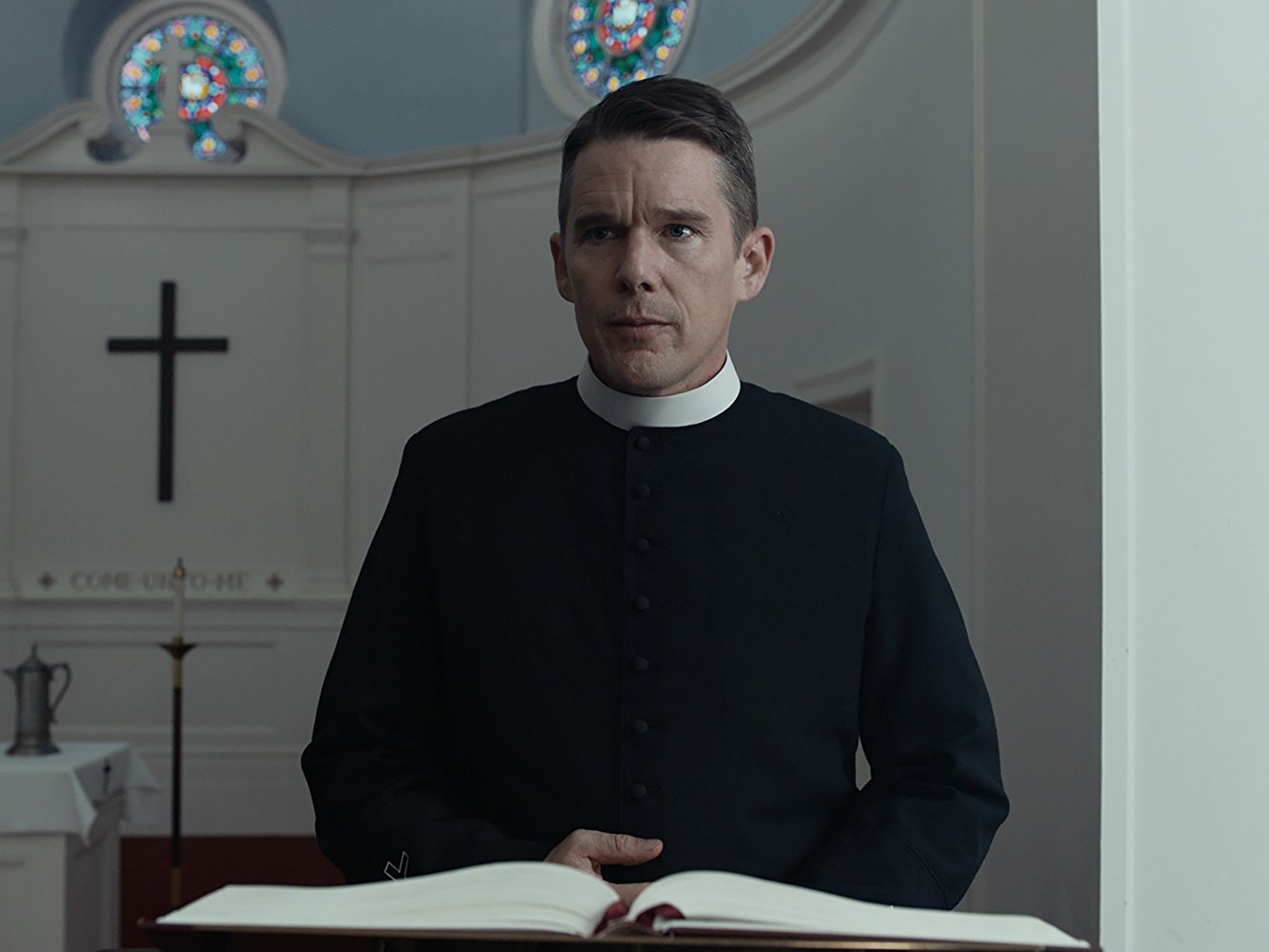
One of the big themes in the movie is sickness. Toller is physically ill, afflicted by perhaps stomach cancer. However, Michael’s death also infects him with the activist’s despair. Toller falls deeper and deeper into the conviction that he has a responsibility towards the earth to fight against climate change. Michael is less of a character and more of a plot technique, and Toller more or less becomes Michael as the movie goes on. Schrader also wrote the script for Taxi Driver, and Toller bears a resemblance to Travis Bickle. Toller is certainly less delusional than Bickle, but both funnel a deeper despair and misanthropy into a cause, fashioning it into a crusade for a nobler goal. Like Bickle, Toller becomes enamored with violence as a means to an end, donning a vest laden with explosives in an (ultimately) abortive attempt to kill Edward Balq (Michael Gaston), head of the BALQ corporation and sponsor of First Reformed’s 250th anniversary celebration.
Toller also shares Travis Bickle’s diaristic impulse, the oration of which serves as the film’s main narrative technique. As much as the movie is about anything, it’s about the frustration of writing and not being able to articulate what you want to say. In fact I saw this as a facet of the movie’s larger desire to show the way in which not just the written word but speech and language itself are often inadequate. Toller’s diary entries routinely frustrate him, and at one point, despite an earlier refusal to cross anything out, he summarily tears out whole pages of the journal and throws them away. Most of the scenes in the movie are dialogic but feature characters talking past each other, or fumbling through ers and ums, or using language to inflict cruelty. Toller repeatedly reflects on the fact that he is unable to muster the will to pray, another frustrated mode of dialogue. There’s a great scene between Toller and Rev. Joel Jeffers (Cedric the Entertainer) that mirrors the conversation between Sherrif Ed Tom and his El Paso counterpart in No Country for Old Men in which Toller complains about a kid who poo-poos his thoughtful response to a question about God and prosperity; Jeffers takes the opportunity to instead give a kids-these-days speech that misses Toller’s point entirely and comforts him not a whit. I think it’s significant that at his breaking point, as Mary arrives at the reconsecration and thus inadvertently thwarts his plans for self-detonation, Toller is reduced to sub-verbal grunts and shouts of anguish.
I wrote above about Schrader’s camerawork: often the camera is static while its characters walk in and out of frame, and shots linger for far longer than commercial films have trained me, hypnotized me really, to see as normal. Thus I found myself studying individual shots more than I normally would, trying to see what Schrader wanted to show me. It seemed to me that the film was shot entirely with natural light, which produces some fantastic shots. The movie is almost bleakly committed to realism, except for one wonderfully-bizarre homage to Koyaanisqatsi near the middle.
 Ultimately the film ends on a note of uncertainty: Mary enters Toller’s room after he has abandoned his plan to blow himself up, instead lacerating himself with barbed wire wrapped around his body like Jesus’ crown of thorns, and the two embrace as the camera circles them over and over. I think Schrader means to make the audience unsure whether or not this consummation really happens or not. The fact that we’ve already been treated to one hallucinatory episode in the movie, the way in which this clashes with the downward arc of despair the movie follows, and the camera’s sudden dynamism after nearly 120 minutes of some of the most static camerawork I’ve seen in a movie, like, ever, certainly left me doubting whether or not this is not just a fantasy of Toller’s broken mind. However I’m not sure that that matters, as Toller, fantasy or not, is unable to truly assume Michael’s mantle and commit political violence whatever the cost. I think that Schrader’s attitude towards radical commitment to a cause is not hollow or cynical, rather that in both First Reformed and Taxi Driver the point is instead the depths a person can sink to when they are tortured by loneliness and hopelessness. I think it’s a thoughtful and very well-made film, though I hesitate to say I enjoyed it, since it’s not exactly a movie which seeks to entertain or distract its audience. I’d recommend it highly, but I’m not sure I’ll watch it a second time; there’s only so much despair I can tolerate in one sitting.
 Theodore Sovinski
Leave a comment